

Diesel Intercultivator & Power Weeder Price in India — 5.5 HP to 8.5 HP
Diesel power weeders in India typically cost between ₹43,000 and ₹1,07,000, depending on engine size. A 7 HP diesel machine costs around ₹43,000–₹50,000; a 9 HP class machine costs ₹72,000 and up. But the purchase price is not what you actually pay — every diesel weeder above 5 BHP qualifies for a government subsidy ceiling of ₹63,000.
That last sentence is worth more than any discount a dealer will offer you, and most buyers never find out about it.
This guide covers what the machines really cost, the exact SMAM subsidy slab your machine falls into, and the six things to check before you hand over money: real specs, real numbers, no “best price” nonsense.
Intercultivator or Power Weeder? Same Machine, Two Names
There’s no difference. None.
“Intercultivator” is the older word. It still turns up in government paperwork and testing reports. “Power weeder” is what dealers and farmers actually say. Same engine, same rotary blades, same job — chewing through soil and weeds between crop rows.
You can see it in our own model codes. The diesel machines are prefixed ICD — as in NB-ICD-C178, or RK-ICD-UP186-SH. That’s Inter Cultivator Diesel. The petrol ones are ICP. So if a page is selling you a “diesel intercultivator,” it’s selling you a diesel power weeder. One machine. Two words for it.
But a power tiller is a different thing entirely
People mix these two up constantly, and it costs them.
A power tiller is the heavier machine — 8 BHP and up, usually — and it’s built to break open ground before anything’s planted. Primary tillage. That’s its job.
A weeder is the lighter one. Narrower body, and the whole point of it is that it fits between rows that already have a crop standing in them. Send a tiller down a planted row and you’ll find out why the distinction matters.
Working tight beds, orchards, very narrow spacing? Then neither — look at the Mini Inter Cultivator instead.
What a Diesel Power Weeder Actually Costs
Across the market, power weeders run from about ₹21,000 all the way to ₹1,85,000.
That range is close to useless, though. It’s got 2 HP hand-guided mini units at the bottom end and a tractor-mounted rotary gear at the top. Neither is what you’re shopping for if you want diesel.
Narrow it to diesel machines in the 7–9 HP class and the picture gets sharper:
| Class | Market price | What that buys |
| 7 HP diesel, 247cc, recoil start | ₹43,000 – ₹50,000 | 32 blades, ~3 ft weeding width, ~1 litre/hour |
| 9 HP diesel, 406–411cc, electric start | ₹72,000 – ₹1,07,000 | 40 blades, ~4 ft width, ~1.25 litre/hour, headlamp, heavier build |
Those are benchmarks from supplier listings. Not quotes.
And here’s the thing about “7 HP diesel” — two machines can both wear that label and be ₹15,000 apart. The gap is in the gearbox (proper gear drive, or a belt drive that’ll give out in year three), the blade steel, whether the rotary is centre-mounted or back-mounted, and what attachments came in the box. The spec sheet won’t tell you. Year three will.
We don’t publish a fixed price list. A farmer buying one machine and a dealer buying forty aren’t paying the same rate, and pretending otherwise would be dishonest. Call +91 90909 24000 or ask for a quote.
The Subsidy Is Worth More Than Any Bargaining You’ll Do
This is the section that pays for itself.
Under SMAM — the Sub-Mission on Agricultural Mechanization, running since 2014-15 under the Ministry of Agriculture and Farmers Welfare, farm machinery is subsidised at 50% for SC, ST, small and marginal, and women farmers, and 40% for everyone else.
But the percentage is only half the story. There’s a ceiling on every machine category, and for weeders, it’s set by engine size:
|
Machine |
SC/ST, small & marginal, women, NE states |
Everyone else |
|
Weeder under 2 BHP |
₹25,000 (50%) |
₹20,000 (40%) |
|
Weeder above 2 BHP |
₹35,000 | ₹30,000 |
| Weeder above 5 BHP | ₹63,000 (50%) |
₹50,000 (40%) |
Look at that bottom row again.
Every diesel weeder from 5.5 HP to 8.5 HP falls into it. The whole range. That’s the top slab available for this class of machine, and if you’re buying diesel, you’re automatically in it.
How the maths actually works
Here’s the bit people get wrong. It’s 50% of the cost or ₹63,000 — whichever is lower. Not both.
Take a ₹50,000 weeder. Half is ₹25,000. That’s well under the ceiling, so ₹25,000 is what you get back. The ₹63,000 figure never comes into it.
Now push the machine toward ₹1,00,000. Half is ₹50,000 — still under the cap. Go higher and the ceiling finally bites, and you’re capped at ₹63,000.
So: on cheaper machines, the percentage rules. On dearer ones, the ceiling does.
Get your papers together first
Nothing here is complicated. But a missing document is the single most common reason an application stalls:
- Aadhaar card
- Record of Rights for the Land
- Passport photo
- Bank passbook copy — not optional, the money comes by Direct Benefit Transfer
- One ID that isn’t your Aadhaar
- Caste certificate, if you’re applying under SC/ST/OBC
Applications go through agrimachinery.nic.in. It’s free. If anyone is charging you to file it, they’re robbing you.
One thing that catches people out: you can’t save the form halfway and come back to it. It has to be done in one go. So don’t open it and then go looking for your passbook. Get everything on the table first.
If you’re in Maharashtra, you’ll probably be going through MahaDBT rather than the central portal directly — same system underneath, different front door.
Two things that will disqualify you
The machine has to be certified. SMAM only backs equipment tested at the four Farm Machinery Training and Testing Institutes (FMTTIs), designated State Agricultural Universities, or ICAR institutions. No certificate, no claim — doesn’t matter how cheap the machine was.
So ask the seller for the test report. Before you pay. If they start getting vague about it, that’s your answer, and you should walk.
You can’t have claimed machinery subsidy before under another central scheme. This one quietly catches people who claimed on some other platform years back and forgot about it.
Our Diesel Range: 5.5 HP to 8.5 HP
That’s the honest range. No 9 HP. No 13 HP. Those machines exist in the market — plenty of people sell them — but we don’t make them, and dressing up the catalogue to catch a search term would be a lie.
| Model | Power | Displacement | Notes |
| NB-ICD-C173-SF / DF | 5.5 HP | 247cc | Classic, 4-stroke, air-cooled |
| NB-ICD-C173-LSF / LDF | 5.5 HP | 247cc | Classic |
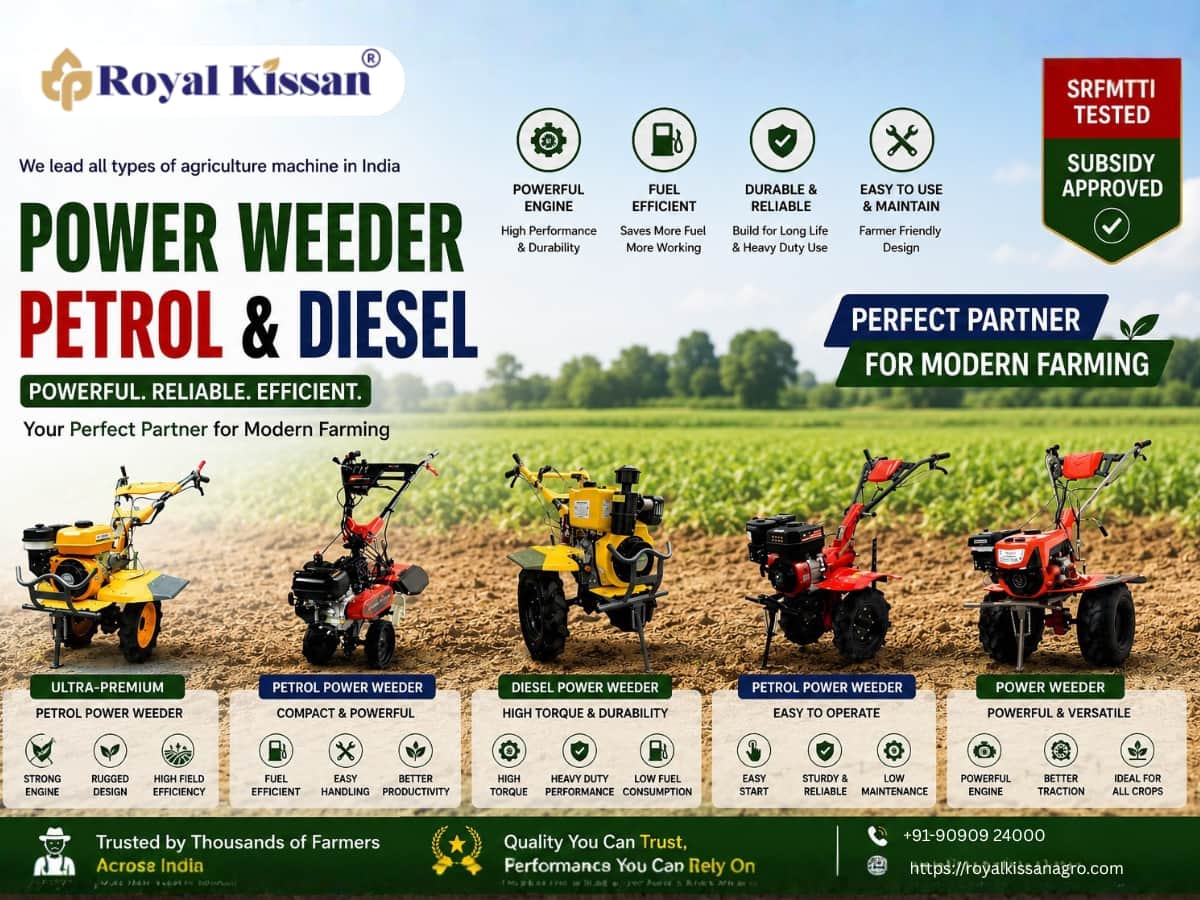
| RK-173F | 7 HP | 247cc | Ultra Premium · FMTTI tested · subsidy approved |
| NB-ICD-C178 | 7.5 HP | — | Classic, 3.5 L tank |
| NB-ICD-C178-E | 7.5 HP | 296cc | Classic |
| RK-ICD-UP186-SH | 7.93 HP | — | Ultra Premium · SRFMTTI tested · subsidy approved · electric start, double fender |
| NB-ICD-C186 | 8.5 HP | 418cc | Classic |
| NB-ICD-C186-LCE | 8.5 HP | 418cc | Classic, electric start |
Engines across the range are 170F, 173F, 177F, and 186F units, turning 3200–3600 RPM, with 3.6 to 4 litre tanks.
Two of these are worth pointing at specifically — and not because they’re the priciest.
RK-173F (7 HP, 247cc) is FMTTI tested and subsidy approved. RK-ICD-UP186-SH (7.93 HP) is SRFMTTI tested and subsidy approved, with electric start and a double fender — which sounds like a small thing until you’re working wet ground and the machine is flinging mud at you all afternoon.
Those certificates are the difference between ₹63,000 back and nothing. That’s the whole reason to care.
In paddy, the RK-173F and NB-ICD-C173-LSF do most of the work — 4 kW at 3200 RPM, enough torque to keep pulling through heavy wet monsoon soil without bogging down. Grape and onion growers tend to go for the NB-ICD-C178 series, 5.22 kW with a 4 L tank.
Diesel or Petrol? The Honest Answer
The internet will tell you diesel is always better. It isn’t.
Diesel makes sense if your soil is hard, black cotton, or full of stones. If the machine’s running for long stretches. If the farm is bigger. Diesel pulls harder at low RPM and costs less per hour to run — that’s genuinely the whole argument, and it’s a good one.
Petrol makes sense if you’re working vegetable beds, orchards, or tight rows. If the machine needs to be light enough to actually turn and lift without wrestling it. If more than one person in the family is going to run it. Petrol starts more easily, shakes less, and is simply kinder to use.
Nobody mentions the cost of diesel, so I will: weight and vibration. An 8.5 HP machine at 418cc is a serious lump of iron. If your real job is weeding between tomato rows, that machine is the wrong tool, and all the torque in the world won’t make it the right one.
Buy for your soil and your crop. Not for the number on the spec sheet.
Six Things to Check Before You Pay
Most buyers check two.
The test report. FMTTI or SRFMTTI. Ask to see it. This isn’t paperwork for the sake of it — it’s what stands between you and a ₹63,000 claim.
The gearbox. Gear drive or belt drive. Gear drive costs more and outlives belt drive by years, especially in wet paddy. Belt drive is where cheap machines quietly cut corners.
The blade steel. Hardened steel holds an edge through stony ground. Soft blades round off in a single season, and you’ll notice it as the machine starts to ride over the soil instead of biting into it.
Blade count and width. A 7 HP machine is typically 32 blades at about 3 ft. A 9 HP is 40 blades at about 4 ft. Wider isn’t automatically better — it has to match your row spacing.
Spare parts. This is the one that ruins people. A machine with no parts pipeline is scrap the day it breaks. We stock spares regionally, with availability committed for five years.
Service reach. Ask where the nearest service point actually is. Not the head office — the nearest one. A dealer two districts away isn’t after-sales support. It’s a phone number.
What It Costs to Run
Around a litre an hour on a 7 HP diesel. Closer to 1.25 on a 9 HP. That’s under normal load — push it through heavy wet soil all day and it’ll drink more.
Do the sum before you buy, not after. At roughly a litre an hour, a full day’s work is a single-digit number of litres. Set that against what you’re currently paying a weeding crew to cover the same ground, and the machine tends to pay for itself faster than people expect — especially once the subsidy has come off the purchase price.
That labour comparison is the actual reason to mechanise. Not horsepower. One person covering ground that used to take a crew, in a season where labour is scarce and getting scarcer — that’s the whole business case, and everything else is detail.
Where These Machines Come From
Royal Kissan Agro has been building and supplying farm machinery since 2020, out of a unit at A-111, Jai Estate, MIDC Phase 1, Dombivli East, Thane 421201.
The company is MSME-registered (Udyam-MH-33-0070229) and holds ISO 9001:2015. More here.
The warehouses matter more than the certificates, honestly. There are eight — Mumbai, Kerala, Tamil Nadu, Hyderabad, Ambala, Kolkata, Guwahati, Lucknow. That’s the reason a spare part can actually reach you in a few days instead of being promised and then not arriving. Anyone can say “pan-India service.” Stock sitting in a warehouse near you is what makes it true.
We also help with the subsidy paperwork. That’s less generous than it sounds — the useful part is that the FMTTI and SRFMTTI certification on machines like the RK-173F and RK-ICD-UP186-SH is already done, and that’s the bit farmers genuinely can’t sort out on their own.
Questions People Actually Ask
What does a 7 HP diesel power weeder cost in India? Roughly ₹43,000 to ₹50,000 for a 247cc machine with 32 blades and about 3 ft of weeding width. The spread comes from gearbox type, blade grade, and what attachments are bundled. We quote per enquiry rather than publishing a list.
How much subsidy can I get? Any weeder above 5 BHP — that’s our whole diesel range — sits in the top slab. Ceiling of ₹63,000 if you’re SC, ST, small or marginal, or a woman farmer (50% assistance). ₹50,000 for everyone else (40%).
Is diesel better than petrol? For hard soil, long hours, and bigger farms, yes. For vegetable rows and orchards, no — petrol is lighter and easier to handle, and that matters more than torque when you’re working tight spacing.
Is an intercultivator the same thing as a power weeder? Yes. Same machine, two names. “Intercultivator” is the older word, and it still turns up in government paperwork; “power weeder” is what people actually say. Look at our model codes, and you’ll see it — ICD stands for Inter Cultivator Diesel.
Then what’s a power tiller? Different machine. Heavier and meant for breaking open ground before planting. A weeder works between rows once the crop is already in.
How much diesel does it burn? About a litre an hour on a 7 HP machine. Closer to 1.25 on a 9 HP. That’s under normal load — push it through heavy wet soil all day, and it’ll drink more.
Do you make a 9 HP or 13 HP diesel weeder? No. Our diesel range stops at 8.5 HP. You’ll find bigger machines elsewhere in the market, but we don’t make them, and we’re not going to pretend otherwise.
The Short Version
Buy for your soil and your rows, not for the horsepower figure on the sticker.
Check the machine is FMTTI or SRFMTTI tested before you pay — that certificate is the ₹63,000.
Look hard at the gearbox and ask a straight question about spare parts. Those two decide whether you own this machine for two years or ten.
And apply for the subsidy. Whatever a dealer knocks off the price, the government is offering more.