

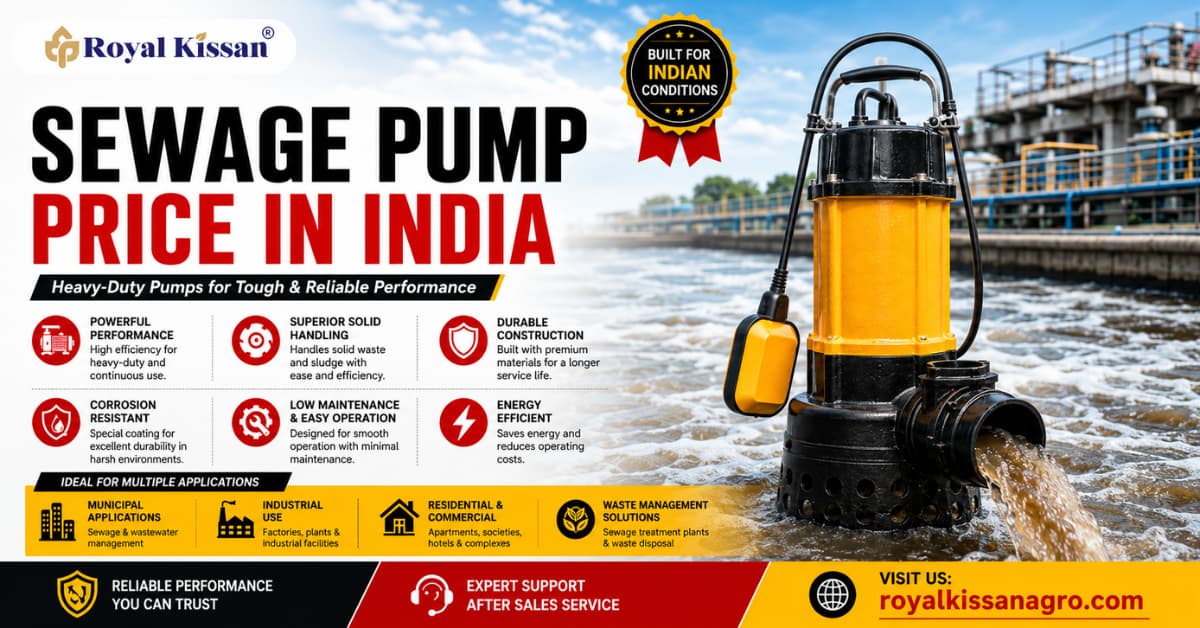
Sewage Pump Price in India (2026): 1 HP and 2 HP Submersible Pumps Explained
A 1 HP sewage pump costs somewhere around ₹6,000 to ₹15,000 in India. A 2 HP, maybe ₹14,000 to ₹20,000.
Then you look at a cutter pump, and the number jumps to ₹31,000. Or ₹36,000.
Same horsepower. More than double the money. Most people assume they’re being cheated, buy the cheap one, and pull it out of the tank three months later with a rag wrapped round the impeller.
So let’s sort out what you’re actually buying.
What These Pumps Cost
Real numbers, from 2026 listings.
| Pump | Type | Listed price |
| Crompton 0.75 HP CDPJ-550 | Standard | ₹6,440 |
| PowerHouse 1 HP | Standard | ₹6,200 |
| Crompton STPM22, 2 HP (single phase) | Standard | ₹14,094 |
| CRI 1 HP SL-2D-07CS (single phase) | Standard | ~₹14,090 |
| Crompton STPM12-10, 1 HP (three phase) | Standard | ₹14,766 |
| CRI 2 HP SL-2V-15DS-A (single phase) | Standard | ₹18,798 |
| Crompton 2 HP single-phase sewage submersible | Standard | ₹19,960 |
| Crompton CCPM12, 1 HP | Cutter | ₹31,482 |
| Crompton CCPM22, 2 HP | Cutter | ₹35,908 |
Look at those last two rows.
₹14,094 for a 2 HP. ₹35,908 for a 2 HP.
Yes, both say 2 HP. No, it’s not a printing error. The difference is inside the pump, and whether you need it depends entirely on what’s going into your tank.
These are other people’s prices, not ours — they show you what the market looks like. For a Royal Kissan quote, ring +91 90909 24000.
Sewage Pump or Water Pump? Not the Same Thing
Right. This is the bit that costs people money, so pay attention for thirty seconds.
A pump moves clean water. Pond, canal, open well. A bit of silt in it is fine. Our petrol RK-WP series does exactly this — surface irrigation, clean sources.
A sewage pump sits in the dirty water. Submerged. Its impeller is built so solids go through instead of jamming.
Swap one for the other, and you’ll break it. That’s not us protecting a warranty clause — it’s just what happens to an impeller that wasn’t made for sludge. You’ll wreck it, and the warranty goes with it.
And a cutter pump?
A standard sewage pump lets solids pass through. A cutter pump chops them up first.
There’s a cutting mechanism inside that shreds rag, plastic, paper, cloth, straw — anything long or stringy — before it can reach the impeller. Standard sewage pumps in the WQD class typically handle solids of about 15 to 25 mm. Fine for silt. Fine for sludge. Fine for short fibre.
Not fine for a rag. Or a sanitary product. Or a plastic bag.
So, one question: does anything get flushed into your tank that a person didn’t stop to think about?
If yes — cutter pump. If it’s genuinely just wastewater and sludge, like a farm drainage pit or a settling tank, a standard pump will do, and you keep the money.
Is the extra ₹20,000 actually worth it?
Do the sum yourself. Roughly: A seized pump means someone has to pull it out of the tank, unwrap whatever’s jammed in it, and put it back. Call that a service visit. If it happens twice a year — and with rag in the tank, it will — you’re paying for that visit twice a year, every year, plus the downtime, plus the smell, plus eventually a new pump when the motor gives up from the strain.
Against a one-time ₹20,000.
We’re not going to invent a callout charge to make the maths look good — you know what a plumber costs in your area better than we do. Just work it out honestly before you buy the cheap one.
How Big a Pump Do You Need?
Horsepower is the answer, not the question. Two other numbers come first.
Head — how high the water has to be lifted, in metres. Not just the vertical bit; the pipe run adds to it too.
Flow — how much water you need shifted, per hour.
Get those, and the horsepower falls out. Buy on horsepower alone, and you’re guessing with a bigger wallet.
Work it out — an example
Say you’ve got a household septic tank.
- The pump sits on the tank floor. The discharge point is 4 m above it. → 4 m vertical
- The pipe then runs 12 m horizontally to get there.
- Pipe friction adds resistance. As a rough working figure, allow roughly 1 m of extra head for every 10 m of horizontal pipe on a small-bore line. So 12 m of run ≈ 1.2 m. Add more if there are bends — every elbow costs you.
- Say two bends. Call it another 1 m, to be safe.
Total head ≈ 4 + 1.2 + 1 = about 6.2 m.
Now you go looking for a pump whose rated head comfortably clears 6.2 m at the flow you need. Not one that just clears it — you want margin.
For context on what a 1 HP class pump looks like: Kirloskar’s ETERNA 750 SW is 1 HP / 0.75 kW, single phase, 40 mm delivery, 2900 RPM on 220 V. That’s the shape of the thing.
Rough guide:
- 1 HP (0.75 kW) — household septic tanks, small sumps, one building
- 2 HP (1.5 kW) — larger tanks, small apartment blocks, commercial premises, or anywhere the lift is high, or the pipe run is long
Get a plumber to confirm your head if you’re not sure. Ten minutes of their time is cheaper than the wrong pump.
The mistake that surprises people
Undersizing is obvious — the pump can’t cope, you notice immediately.
Oversizing is the sneaky one.
Put a pump in that’s rated for far more head than it actually has to work against, and it draws more current than it should. The thermal protector inside then trips to save the motor. So it stops. You reset it. It stops again.
For this class of pump, the trouble usually starts once you’re running below about 80% of the rated head. Keep resetting it, and you’ll eventually burn something out.
So no — bigger is not automatically safer. Match it to the lift you actually have.
What Breaks, and Why
We build these. Here’s what actually goes wrong.
It clogs
The commonest one by miles. Almost always a selection mistake, not a manufacturing one. Solids too big for the impeller, or fibre wrapped around the shaft.
The cutter pump solves it. A cheap standard pump in the wrong tank doesn’t.
It burns out
Two things to look for on the spec sheet, and both get quietly left off cheap pumps.
Copper winding with a thermal protector. The protector cuts the power when the motor overheats or pulls too much current. It is the one feature standing between a bad afternoon and a dead pump.
A proper mechanical seal — double-sided, between motor and pump body.
The seal keeps grit away from the shaft. Sounds minor. It isn’t. Seal goes, water gets into the motor, and that’s that. Pump’s dead. No repair worth doing.
It runs dry
Float switch. Get one.
It shuts the pump off when the water drops too low, turns it back on when the level comes up. Costs almost nothing.
Without it, someone has to remember to switch the pump off. And one day, someone won’t. The pump runs dry and cooks itself. That’s not pessimism — that’s just how it goes.
What We Actually Make
Three kinds of pumps. That’s the whole list, and it’s worth being precise, because there’s plenty we don’t make.
Submersible sewage pumps — WQD series
For drainage, wastewater, and sludge. Clog-resistant impeller, runs submerged.
SPEC TABLE — FILL THIS IN BEFORE PUBLISHING
| Model | HP / kW | Flow (m³/h) | Head (m) | Discharge (mm) | Phase | Float switch | Cutter |
| [code] | 1 HP / 0.75 kW | Single | |||||
| [code] | 2 HP / 1.5 kW | Single |
This is the blocker. Nobody buys a “1 HP sewage pump” from a page that never says what your 1 HP sewage pump is. Fill it in, or the page can’t do its job.
Petrol water pumps — 1 HP to 5.1 HP
Cast iron body, 4-stroke engine. Compact 98CC at one end, 212CC high-discharge at the other. The RK-WP-P1.5 (98CC) is what most farmers use to pull water off a pond or an open channel.
Clean water only. These cope with a bit of sediment. They do not cope with sludge, and putting one into sewage will destroy it.
Power tiller pump attachments
This is the odd one, and it’s the one we’re proudest of.
It bolts a pump onto a tiller you already own, driven off the PTO through a gear or belt. No second engine to buy.
The RK-PW-WP-P80 runs 3-inch (80 mm) ports, shifts up to 40 m³/h, pushes to 40 m of head with 7 m of suction, off a 14 mm PTO shaft at 3600 RPM.
If you’ve already got a tiller sitting there, this is the cheapest serious water you’ll ever move.
Petrol or Electric? Three Questions
Is your power supply reliable?
If the grid comes and goes, an electric pump works when it feels like it. Petrol doesn’t care.
Do you need to move it around?
Petrol is portable — carry it between fields, between water sources. A submersible goes into a tank and stays there.
Clean water or dirty?
Clean surface water, petrol is fine. Sewage or sludge, you need a submersible. No argument there.
Short version: patchy power and a pond → petrol. Stable power and a tank → submersible. Got both? Buy both. They’re doing different jobs.
Who You’re Comparing Us Against
You’re probably also looking at these. Here’s an honest read.
| Brand | Known for | Where they beat us |
| Royal Kissan | Agricultural pumps. Petrol, submersible, tiller attachments. | Tiller pump attachments — a category the big names largely don’t touch. |
Several of these companies have been making pumps for longer than we’ve been a company. We started in 2020. Pretending we out-engineer Kirloskar would insult you.
Where we genuinely think we’re worth your time: we make pumps for farms. And the tiller attachment is something you simply can’t buy from most of the names above.
Where we’re not the right call: if you’re plumbing an apartment basement in a city, go to one of the big names. That’s their world, not ours.
Buying, Servicing, Spares
Where do we supply from
Six warehouses. Thane (Maharashtra), Coimbatore (Tamil Nadu), Palakkad (Kerala), Hyderabad (Telangana), Ambala (Haryana), Lucknow (Uttar Pradesh).
That’s the honest map. We’re not going to claim cities we don’t have — you’d find out, and it’d be our fault.
Servicing a petrol water pump
Not much to it:
- Engine oil — every 50 hours of running
- Air filter — clean every 25 hours
- Spark plug — check once a season
- Cast iron pump body — nothing routine. Just clear the muck off the inlet strainer.
That’s the whole job.
Servicing a submersible
Less to do, but less forgiving when you skip it. Check the seal. Check the float switch still swings freely — they gum up in a sewage tank, and a stuck float is a pump that never switches off.
And if it starts tripping the thermal protector, don’t just keep resetting it. Something’s wrong. Usually the head.
Questions People Ask
What does a 1 HP sewage pump cost in India?
Standard, about ₹6,000 to ₹15,000 depending on brand and build. A 1 HP cutter version is a lot more — around ₹31,000.
What does a 2 HP sewage pump cost?
Standard, about ₹14,000 to ₹20,000. Cutter version, closer to ₹36,000.
Can I just use a normal water pump for sewage?
No. It’ll break. Irrigation pumps are built for clean water — solids and sludge will wreck the impeller, and you’ll void the warranty on the way. You need a submersible built to pass solids.
What size do I need for a septic tank?
A 1 HP will do for most household tanks and small sumps. Bigger tank, apartment block, or a long pipe run to the discharge point — go to 2 HP. But measure your lift first. Horsepower on its own tells you nothing.
What’s the difference between a sewage pump and a cutter pump?
Standard pumps let solids pass through — about 15 to 25 mm. Cutter pumps shred rag, cloth, plastic, and paper before it reaches the impeller. If anything gets flushed into your tank, you want a cutter.
Do I need a float switch?
Get one. It kills the power when the water drops too low, so the pump can’t run dry and cook itself. Costs very little. Without it, somebody has to remember — and somebody won’t.
Why does my pump keep tripping?
Usually, the head is wrong. Run a submersible well below its rated head, and it pulls too much current, so the thermal protector cuts in to save the motor. It’ll keep doing that until you fix the sizing. Don’t just keep hitting reset — you’ll burn something out.
The Short Version
Measure your head before you look at a single price.
Ask what gets flushed into the tank. Rag, cloth, plastic — buy the cutter pump. Just sludge — don’t bother.
Check for copper winding, a thermal protector, and a proper mechanical seal. That’s what separates a pump from a paperweight.
Get the float switch.
And don’t ever put an irrigation pump into sewage. It’s the most expensive shortcut in this entire category.
+91 90909 24000 · info@royalkissanagro.com