
What Is a Portable Power Sprayer?
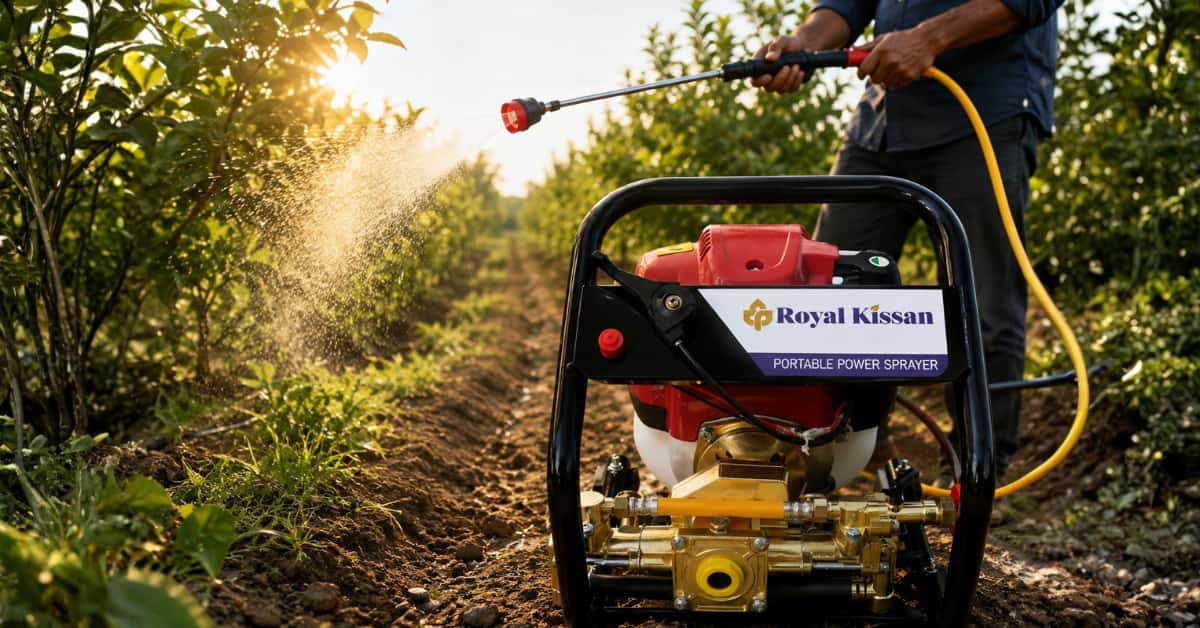
A portable power sprayer is a motorised machine that applies pesticides, fertilizers, herbicides, fungicides, and other liquid chemicals across crops, gardens, or surfaces. A manual pump sprayer makes you work for every drop, pumping by hand for the whole job. A power sprayer doesn’t. An engine or electric motor keeps the pressure steady from start to finish, so you get less fatigue, better coverage, and the work is done a lot faster.
The “portable” part earns its name, too. You can carry these on your back knapsack-style, hold one in your hand, or wheel it down a tight row between plants. No tractor required, and no fixed setup of any kind.
How It Actually Works
The motor or engine drives a pump, usually a piston or diaphragm type, which pressurizes the liquid sitting in the tank. That pressurized liquid runs through a hose to the nozzle, where it comes out as a fine mist, a hard jet, or something in between, depending on which nozzle you fit. You aim and cover ground by moving the wand or gun. The pressure looks after itself.
Types of Portable Power Sprayers Available in India
Indian manufacturers stock a fairly wide range. Three configurations cover most of what you’ll actually run into, and each one suits a different kind of job.
Battery-Operated Knapsack. Runs off a 12V battery, either sealed lead-acid or lithium-ion. You’ll see 12V 8Ah, 12V 12Ah, and 12V 14Ah configurations most often, with tanks in the 16 to 20 litre range. It’s quiet, simple to maintain, and there’s no fuel to mix. Expect four to six hours of continuous spraying per charge.
2-Stroke Petrol Engine. A compact 2-stroke petrol engine drives a high-pressure piston pump on these. They’re light and easy to move around, though you’ll need to mix oil into the fuel. Tanks usually run 12 to 20 litres. This is the workhorse for medium farms and open fields, the kind of thing you’d reach for on cotton, rice, or vegetables.
4-Stroke Petrol Engine. GX-35 style engines are the common choice, around 38cc and roughly 1 kW. You get better fuel economy and cleaner emissions than a 2-stroke, and most units ship with a 15m hose, a brass pump, and a recoil starter. The 20L tank is standard. If you’re working large farms, orchards, hilly ground, or simply spraying day after day, this is the one.
Technical Specifications at a Glance
|
Specification |
Battery-Operated | 2-Stroke Petrol |
4-Stroke Petrol |
|
Typical Tank Capacity |
16-20 L | 12-20 L |
20-25 L |
|
Power Source |
12V Battery | Petrol + Oil Mix |
Pure Petrol |
|
Engine Displacement |
N/A | 26-52cc |
35-50cc |
|
Pump Type |
Diaphragm / Piston | Piston (Brass) |
Piston (Brass) |
|
Typical Hose Length |
Included (3-6m) | 15m+ |
15m+ |
|
Output (approx.) |
4-6 L/min | 6-8 L/min |
6-8 L/min |
|
Best For |
Medium farms, gardens | Open field crops |
Large farms, orchards |
|
Maintenance Level |
Low | Medium |
Medium-Low |
Key Applications: Who Actually Uses These?
Power sprayers stopped being purely farm kit a while ago. Demand has spread into a surprising number of sectors across India.
Agriculture · Horticulture · Sericulture · Tea & Coffee Estates · Forestry · Gardens & Nurseries · Sanitization · Vehicle Washing · Industrial Cleaning
Agriculture. This is still the core job: spraying insecticides, pesticides, fungicides, herbicides, and liquid fertilizers on standing crops. Paddy, wheat, cotton, sugarcane, vegetables, they all suit a portable power sprayer. For taller crops, go with a high-pressure model and a longer hose so you can reach the canopy.
Horticulture and Plantation Crops. Tea gardens, coffee estates, mango orchards, vineyards. A tractor-mounted rig often can’t get into this kind of terrain, and that’s where the backpack design wins. It handles uneven, hilly ground and squeezes into the narrow gaps between rows where bigger machines simply don’t fit.
Sericulture and Forestry. Mulberry plantations grown for silkworm rearing, plus forestry work that needs disease control and canopy treatment, both lean on portable sprayers for their reach and the fact that you can take them just about anywhere.
Sanitization and Public Health. Then COVID-19 happened, and portable sprayers found a whole new line of work. Disinfecting public spaces, hospitals, schools, and commercial buildings. Plenty of municipalities and private contractors across India still use them for public health jobs today. Royal Kissan, like several other Indian manufacturers, lists sanitation and public health among the core uses for its 4-stroke portable models.
Cleaning and Industrial Use. The same pressure that pushes pesticides onto a crop will just as happily clean a grove shed, a vehicle, an industrial floor, or the outside of a building. That flexibility is a big part of why small businesses, not only farmers, find these machines worth buying.
The Market Behind the Machine
A quick look at the numbers explains why India matters so much as a manufacturing and supply base.
|
Figure |
What it means |
|
USD 5.10B |
Global ag-sprayer market value, 2025 |
|
6.8% |
Global CAGR projected through 2030 |
|
8.1% |
India market CAGR, 2024 to 2032 |
|
~40-45% |
Current farm mechanization level in India |
Mordor Intelligence puts the global agricultural sprayer market at USD 5.10 billion in 2025, on track to reach USD 7.08 billion by 2030. Asia-Pacific holds the largest revenue share of any region, and a good chunk of that comes down to government subsidy programs in India and China that push machinery adoption.
India’s domestic sprayer market was valued at roughly USD 135.30 billion in 2024 and is forecast to reach USD 219.83 billion by 2032, a CAGR of 8.10%. That’s quicker than the global pace. Factor in a farm mechanization level of only 40 to 45%, with more than 60% of India’s land under agriculture (World Bank), and there’s clearly a lot of room left to grow.
All of that demand feeds straight back into domestic manufacturing. More demand brings more factories, more competition, and for buyers, sharper prices and a deeper pool of quality Indian-made products to choose from.
Government Support: How Subsidies Change the Maths
Here’s something every buyer in India should have on their radar. The central government actively subsidizes farm machinery purchases, sprayers included, and it can change your real cost dramatically.
Sub-Mission on Agricultural Mechanization (SMAM)
SMAM has been running since 2014-15 under the National Technical and Extension Mission. It lets farmers claim financial subsidies on a broad list of equipment: sprayers, tractors, power tillers, seed drills, and more. The funding split is 90% central and 10% state in the northeastern and Himalayan states, and 60% central to 40% state everywhere else.
|
Rate |
Applies to |
|
50% |
SC/ST farmers, small & marginal farmers, and women farmers |
|
40% |
All other eligible farmers |
|
50-80% |
Broader government refund range on qualifying sprayer purchases |
The scheme also funds Farm Machinery Banks (FMBs) and Custom Hiring Centres (CHCs) at the village level, so farmers who can’t buy outright can rent a machine cheaply instead. SMAM is still a central plank of the government’s modernization drive in 2025, and the revised operational guidelines issued in May 2025 now cover farm drones and precision agriculture tools as well.
If you’re an institutional buyer or a dealer selling on to farmers, it pays to check whether your products fall under SMAM-eligible categories. That subsidy makes the whole purchase a lot more appealing to the person at the end of the chain.
Where Sprayers Are Made in India
The industry is spread across several long-established manufacturing cities. If you’re buying in bulk or planning a factory visit, the geography is worth knowing.
|
City / Region |
State |
Known For |
|
Ludhiana |
Punjab |
One of India’s oldest machinery belts, producers running since the 1970s, engine-based and agricultural sprayer specialists |
|
Rajkot |
Gujarat |
A mix of engine-operated and battery-powered models; strong agro-equipment export base |
|
Coimbatore |
Tamil Nadu |
Sprayer components and assembled units; known for solid build quality |
|
New Delhi & NCR |
Delhi |
Major wholesale and distribution hub; suppliers serving the whole country with bulk capacity |
|
Ahmedabad |
Gujarat |
Growing base of agri-equipment exporters, specialty makers, steel and stainless models |
|
Indore |
Madhya Pradesh |
Mid-range and high-capacity producers; central India distribution hub |
|
Nashik |
Maharashtra |
HTP-type portable sprayers; producers focused on Made-in-India certification |
What to Look For When Comparing Sprayers
Once you’re actually comparing models, these are the things that genuinely move the needle. Hold each one against your own situation before you commit.
Tank Capacity. For a small garden or spot jobs, 12 to 16 litres is plenty. For a medium farm, 20 litres tends to be the sweet spot: fewer refill trips without piling on weight. Anything past 25L suits high-output commercial work, but it gets heavy on your back over a long session.
Power Source. Battery models are quiet, low-maintenance, and cost nothing to fuel, but you’ll need to factor in charging time and plan around four to six hours of runtime per charge. Two-stroke petrol engines are light and cheap, with the catch that you have to mix oil into the fuel. Four-stroke engines (the GX-35 type) run on straight petrol, sip less of it, emit less, and hold up better when the job is long or demanding.
Pump Type and Material. Brass pumps shrug off chemical corrosion far better than plastic ones. Diaphragm pumps hold pressure well and clog less often. If you’re regularly spraying corrosive pesticides or fertilizers, brass is money well spent.
Tank Material. Go for HDPE (High-Density Polyethylene) or UV-stabilised virgin plastic. Both take sustained sun better and resist chemical wear over time. Ordinary plastic tends to turn brittle and crack after a season or two of hard use.
Nozzle Options. Aim for at least two: a fine mist for covering wide areas and a direct jet for tall crops or targeted spots. An interchangeable nozzle kit gives you a lot more room to adapt across different crops and chemical mixes.
Ergonomics and Carrying Comfort. If the machine is on someone’s back for four to six hours a day, padded straps and a proper lumbar panel aren’t luxuries. They cut operator fatigue, and that feeds straight into how much work actually gets done. Check the strap width and how the weight sits when the tank is full.
Warranty and Spare Parts. A one-year warranty is the baseline now for powered models. What matters even more is whether you can actually get genuine spares: pump heads, hose sets, nozzle kits, filter screens. A machine stuck idle for three weeks waiting on a part during peak sowing can end up costing you more than a pricier model that never leaves the field.
What These Cost in India
Price depends on engine type, tank size, pump quality, and where the brand sits in the market. The ranges below reflect current listings across the major B2B and retail platforms in 2025-26.
|
Segment |
Description | Price Range (₹) |
|
Entry-Level Battery |
16L, 12V 8Ah, single motor, basic nozzle |
₹5,500 to ₹9,500 |
|
Mid-Range Battery |
16-20L, 12V 12Ah, double motor, 4 nozzle types |
₹9,500 to ₹13,000 |
|
2-Stroke Petrol |
12-20L, brass pump, 15m hose, recoil start |
₹8,900 to ₹12,500 |
|
4-Stroke Petrol |
20-25L, GX-35 engine, brass pump, 15m hose |
₹12,500 to ₹20,000 |
| Professional / HTP Grade | High-pressure, large tank, commercial use |
₹20,000 to ₹29,500+ |
For bulk or wholesale orders, usually a minimum of 30 to 50 units, most Indian suppliers will sharpen their pricing considerably. Always ask for a volume quote as a separate conversation from the retail sticker price.
Sizing Up a Manufacturer or Supplier
If you’re placing a serious order, or you want a supplier you can keep going back to rather than a one-off deal, the evaluation runs deeper than the spec sheet.
How long have they been at it? The established names, some going back to the 1970s, tend to have steadier processes, more institutional know-how, and supply you can count on.
Do they handle bulk and wholesale? A lot of Indian suppliers set a minimum order, often 30 to 50 pieces, before they’ll quote factory-direct prices. Pin down the MOQ before you start negotiating.
Is it actually Made in India? Plenty of B2B listings come from traders, not manufacturers. If Made-in-India is part of your procurement criteria, confirm where the machines are built rather than taking the listing’s word for it.
Can they supply genuine spares? Ask specifically about availability and lead times on pump heads, hose sets, spray guns, and filter screens. A reliable spares chain matters as much as the machine.
What certifications do they hold? ISO certification and GST verification are decent baseline signs that the business is mature and legitimate.
What’s the after-sales support like? Get clarity on warranty cover, service centres, and how fast they respond to complaints before you commit.
Can they deliver across India? Many suppliers in Ludhiana, Rajkot, and Delhi will arrange transport to any state. Confirm freight terms and transit time, especially on large orders.