
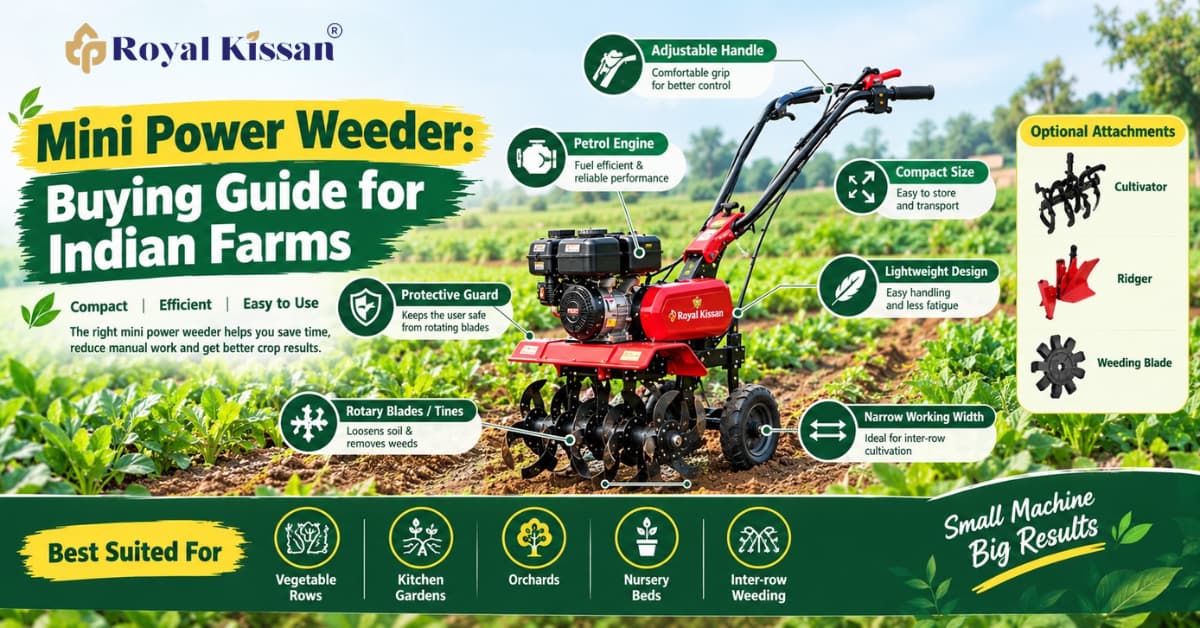
Mini Power Weeder: Cultivator and Tiller Buying Guide for Indian Farms
A mini power weeder is a compact, engine-powered machine built for precise weed removal and soil cultivation on small plots, orchards, and nurseries, where a full-sized power tiller is more machine than the job needs. This guide covers what a mini power weeder does, how it differs from a mini tiller and a rotavator, and what to check before buying one in India.
Key Takeaways
- A mini power weeder handles inter-row cultivation, secondary tillage, weeding, and soil aeration in a single walk-behind pass, replacing several people’s worth of hand-hoe labor with one operator.
- 82cc-class mini tillers and weeders sit at the lightweight end of the range, suited to already-workable soil, home gardens, and small vegetable plots rather than breaking new or compacted ground.
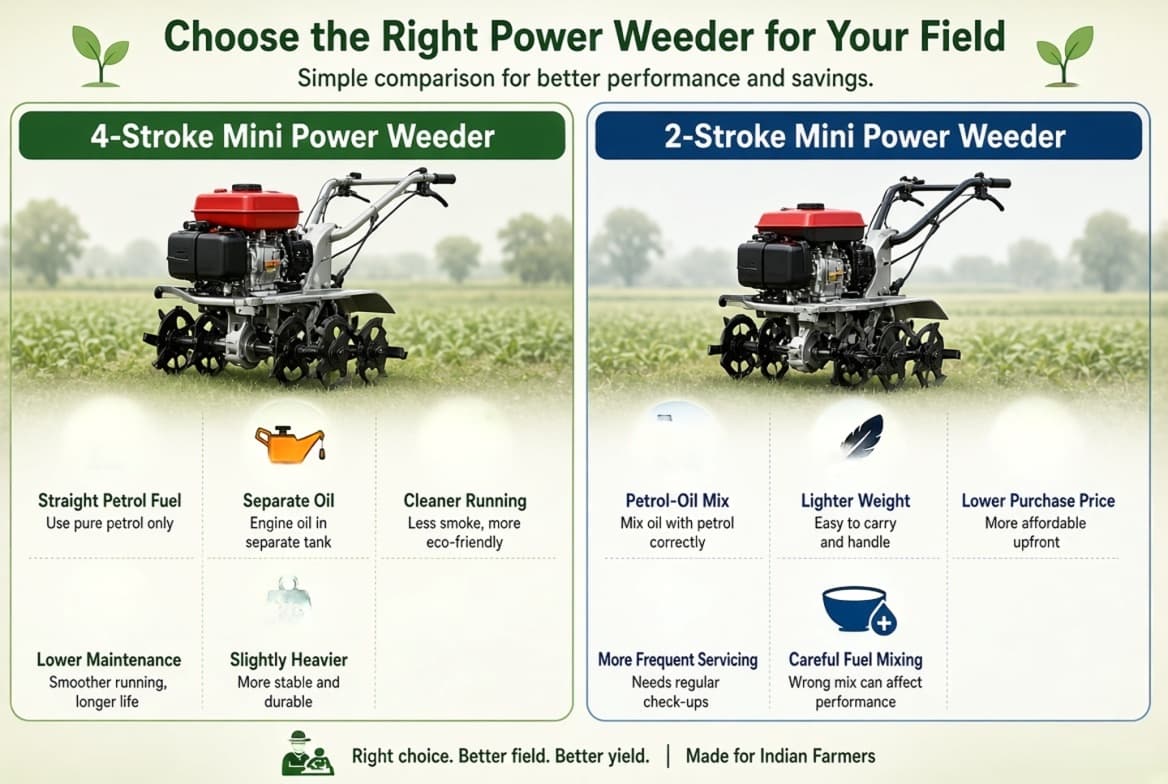
- 4-stroke models run cleaner with less routine maintenance; 2-stroke models are lighter and cheaper upfront but need more frequent servicing and careful fuel mixing.
- Price on a mini tiller depends on engine size, stroke type, build quality, and certification, not a single fixed number, and the lowest listed price often excludes local dealer support.
- Mini weeders are built for dry-land soil; heavier diesel weeders, not lightweight mini models, are the right fit for puddled paddy fields.
Table of Contents
- Key Takeaways
- Power Weeder Cultivator and Tiller
- What’s the Difference Between the Three?
- Power Weeder for Soil Cultivation and Weed Removal
- Soil Aeration as a Secondary Benefit
- 82cc Mini Power Tiller Cultivator Weeder
- What This Spec Means for Buyers
- 4 Stroke Mini Power Weeder vs 2 Stroke
- India’s Best Prices on Mini Power Tillers
- What Actually Drives Cost
- What Is the Difference Between a Tiller and a Rotavator?
- Why Machines Struggle in Rice Cultivation
- Power Weeder and Tiller Manufacturer in India
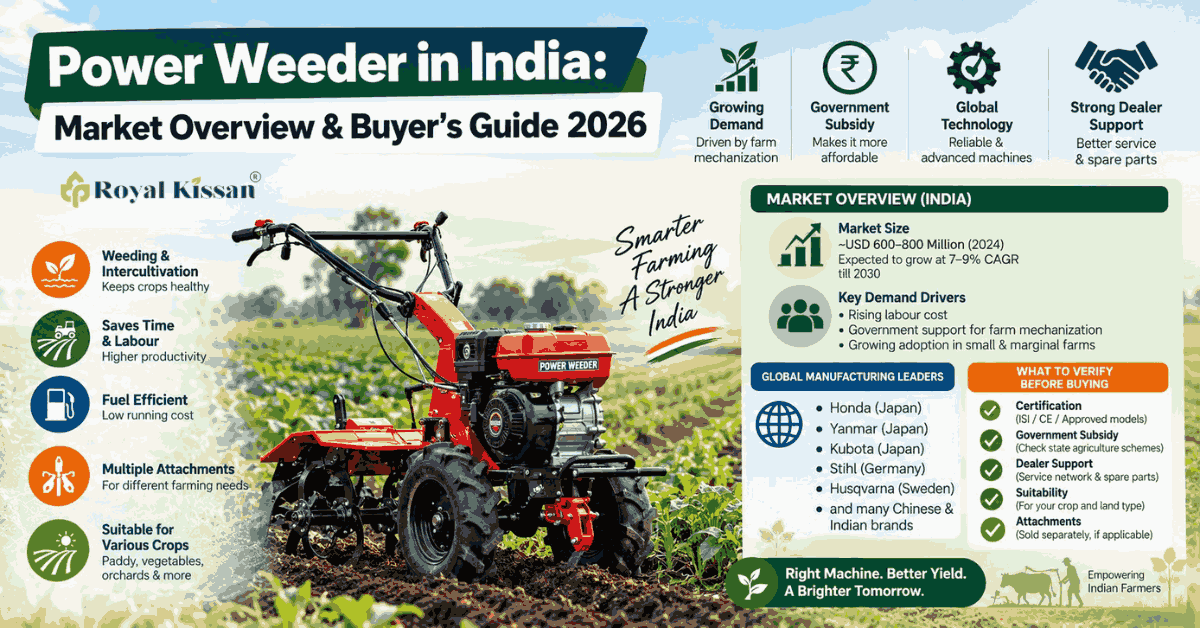
- What to Verify Before You Buy
- Royal Kissan’s Credentials
- Buy Power Weeders and Tillers
- Buy Power Weeders Online in India
- Royal Kissan Mini Inter Cultivator
- Buy Power Weeders Online in India
- The Bottom Line
- Frequently Asked Questions
Power Weeder Cultivator and Tiller
What’s the Difference Between the Three?
All three terms get used loosely in Indian agricultural machinery listings, but they describe slightly different jobs. A power weeder is built to remove weeds and loosen soil close to an existing crop row without disturbing the roots. A cultivator does similar shallow work, typically at 2 to 4 inches deep, mixing in fertilizer or breaking up crusted topsoil. A tiller, including a mini power tiller, works deeper and more aggressively, meant for breaking new ground or preparing a seedbed from scratch rather than maintaining an existing row.
A mini power weeder cultivator, in practice, is usually a single compact machine that handles both light tilling and inter-row weeding, which is why the terms blur together in product names. What matters for a buyer is matching the machine to the actual job: ongoing weed control between rows calls for a weeder-style machine; breaking new ground calls for a tiller.
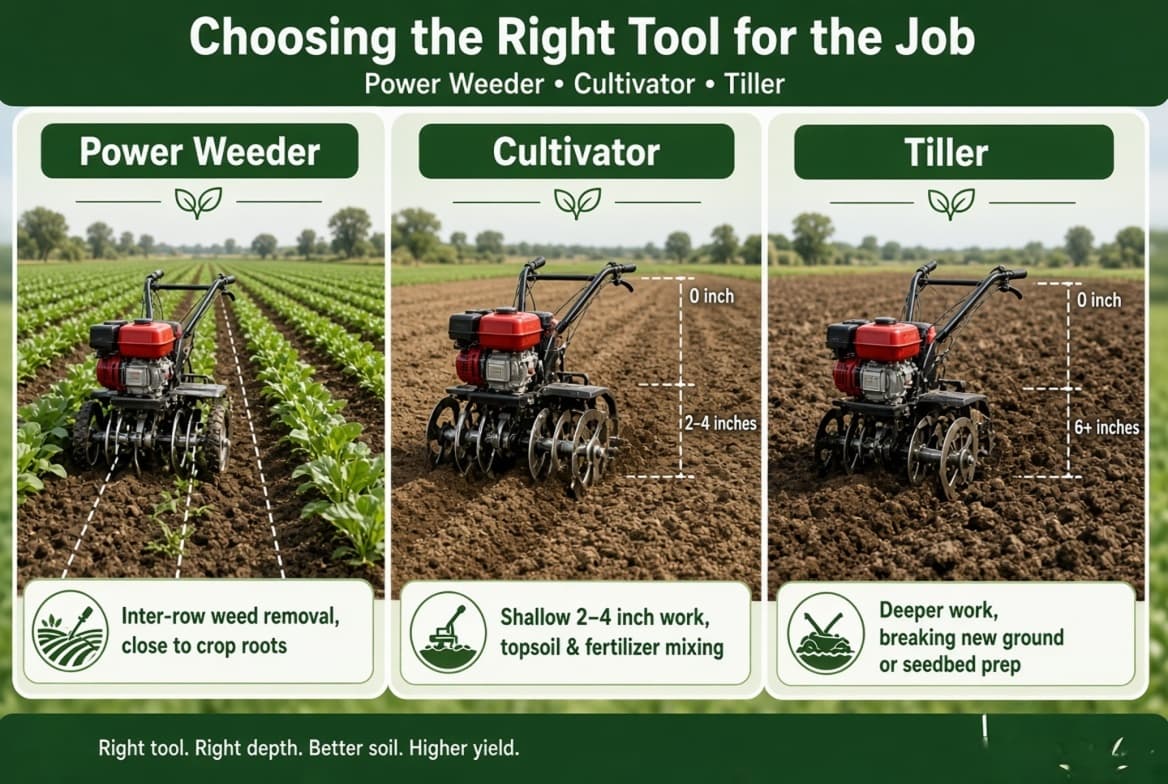
Cultivator – Shallow 2–4 inch work, topsoil & fertilizer mixing
Tiller – Deeper work, breaking new ground or seedbed prep
Power Weeder for Soil Cultivation and Weed Removal
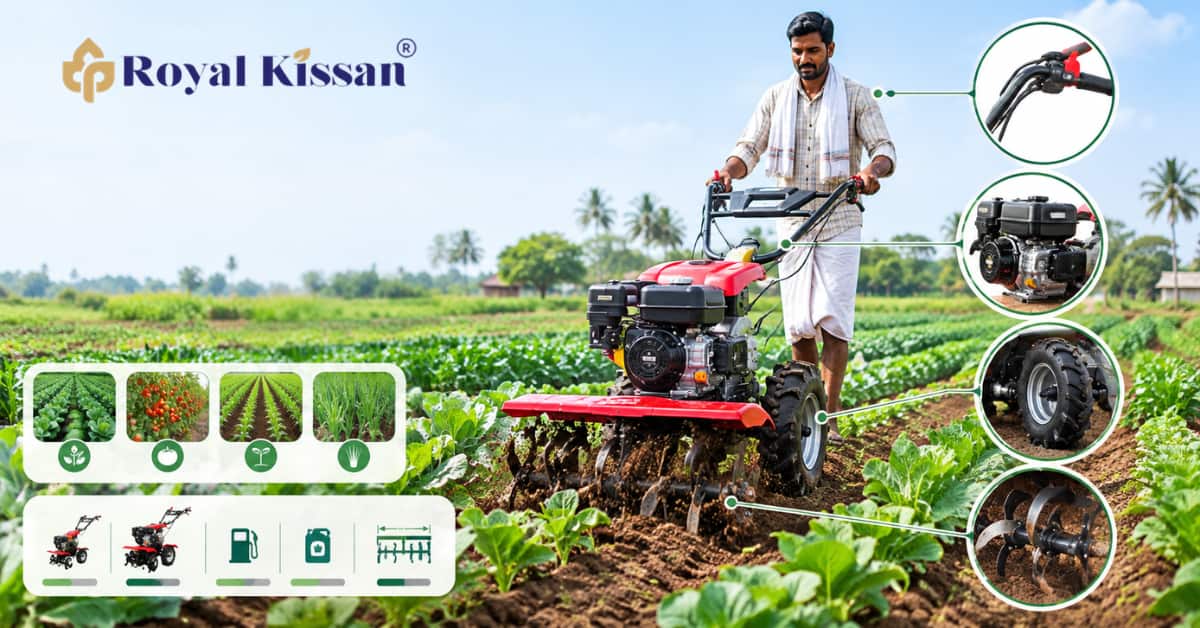
A mini power weeder’s main uses are inter-row cultivation, secondary tillage, weeding, and soil aeration, replacing hand-hoe labor with a single walk-behind pass. On small plots, orchards, vineyards, and nurseries, this typically means one operator covering ground that would otherwise take several people working by hand, which lowers labor cost and frees that labor for other time-sensitive farm work.
Soil Aeration as a Secondary Benefit
Loosening compacted soil near the root zone improves water and nutrient uptake, which is a secondary benefit beyond the obvious weed control, particularly on vegetable and orchard soils that get walked on and compacted repeatedly through the season.
82cc Mini Power Tiller Cultivator Weeder
An 82cc engine sits at the small end of the mini tiller and weeder range, common across two-stroke, air-cooled models built for lightweight, low-cost soil work. At this engine size, expect a compact frame, easy one-person handling, and enough power for loosening already-workable soil, home gardens, and small vegetable plots, but not for breaking new, compacted, or rocky ground.
What This Spec Means for Buyers
Buyers comparing 82cc-class machines should look past the cc figure alone and check the actual power output (often in the 3.5 to 5 HP range depending on the model), tilling width and depth, and whether the engine is two-stroke or four-stroke, since that affects both maintenance and fuel handling.
4 Stroke Mini Power Weeder vs 2 Stroke
A 4-stroke mini power weeder runs on straight petrol, with oil circulating separately inside the engine, which generally means cleaner running and less routine maintenance. A 2-stroke model runs on a petrol-oil mix and is typically lighter and simpler, which keeps upfront cost down, but requires more careful fuel mixing and tends to need more frequent servicing over time.
Neither is a strictly better choice. A 4-stroke suits farms wanting lower ongoing maintenance and don’t mind a slightly heavier machine; a 2-stroke suits buyers prioritizing lower purchase price and lighter weight for occasional, small-plot use.
India’s Best Prices on Mini Power Tillers
There’s no single fixed price for a mini power tiller in India, since cost depends on engine size, stroke type, build quality, and whether the model carries any testing or certification.
What Actually Drives Cost
A basic 63cc to 68cc two-stroke model prices lower than an 82cc or larger four-stroke unit with a gear-drive system and reinforced frame. Rather than chasing the lowest listed number, compare what’s included at that price: engine warranty, spare parts availability, and whether a real dealer exists near you for servicing. A cheaper machine with no local service point often costs more over its lifetime than a slightly higher-priced one backed by a proper dealer network.
What Is the Difference Between a Tiller and a Rotavator?
A tiller, including compact mini tillers, is generally a standalone walk-behind machine with its own engine, suited to small plots, gardens, and inter-row work. A rotavator (rotary tiller) is typically a larger, tractor-mounted implement designed for deeper, primary tillage, breaking and turning soil across a full field before planting, often at 6 inches or more compared to a tiller’s shallower working depth.
The practical difference for a small or marginal farmer comes down to scale and equipment ownership. A mini tiller or power weeder works as a standalone machine sized for a small plot; a rotavator needs a tractor to run behind, which makes sense on larger holdings but isn’t a realistic or necessary purchase for a nursery, vegetable patch, or orchard row.
Why Machines Struggle in Rice Cultivation
Weeding and tilling machinery see less use in paddy fields than in dry-land crops, mainly because of how rice is grown. Rice cultivation has traditionally been described as “hoe-culture,” a method not well suited to mechanization, since paddy fields are flooded and puddled before planting. Machines need more power to move through puddled, waterlogged soil, and efficiency drops further in small, uneven, or irregularly shaped fields, a description that fits a large share of Indian paddy plots.
This is part of why lightweight mini weeders, built mainly for dry-land vegetable and orchard soil, aren’t the right tool for paddy fields. Heavier, diesel-powered weeders built specifically for wet, heavy soil handle that job better; a mini power weeder’s strength is dry, lighter cultivation work instead.
Power Weeder and Tiller Manufacturer in India
What to Verify Before You Buy
Before buying from any manufacturer, check for a few concrete signals rather than relying on marketing language alone:
- MSME Udyam registration, confirming the company is a recognized, registered manufacturer rather than an unregistered reseller.
- ISO 9001:2015 certification, indicating a documented, consistent quality management process across production.
- FMTTI or SRFMTTI testing on the specific model, relevant if you plan to apply for any state subsidy scheme, though mini weeders at the lower HP end are less commonly subsidy-listed than mid-range and heavier models.
- An actual dealer or service point near you, since mini weeders still need blade, filter, and engine servicing over their working life.
Royal Kissan’s Credentials
Royal Kissan is an MSME Udyam-registered manufacturer (Udyam-MH-33-0070229), ISO 9001:2015 certified, positioned as a leading agricultural machinery manufacturer with a pan-India dealer network covering mini tillers, power weeders, and related spare parts.
Buy Power Weeders and Tillers
Royal Kissan’s range covers mini power weeders, mini tillers, and cultivators for small and medium farms, alongside the mid- and higher-HP power weeder lines for larger plots. All models are available for purchase through the dealer network rather than direct online checkout.
Buy Power Weeders Online in India
Enquiring online is the starting point for most buyers: submit a request for the specific model through the manufacturer’s website, and a dealer in your area follows up with current pricing, availability, and a demonstration if needed.
Royal Kissan Mini Inter Cultivator
The Mini Inter Cultivator (model RK-MI-KS02) is a compact 150cc engine model delivering approximately 4 HP at 3600 RPM, built for inter-row cultivation, secondary tillage, weeding, and soil aeration on vegetable farms, orchards, vineyards, and nurseries. It’s designed with ergonomic controls and accessible components for routine maintenance like filter checks and lubrication. As with other Royal Kissan machines, pricing isn’t published as a fixed online list.
Mini Power Weeder: A compact, engine-powered, walk-behind machine, typically under 100cc or up to about 5 HP, built for weeding, light tilling, and soil aeration on small plots, orchards, and nurseries, as distinct from larger tractor-mounted implements.
The Bottom Line
A mini power weeder earns its place on a small or medium farm by replacing hand-hoe labor with a single walk-behind pass, but the engine spec on the listing only tells part of the story. Stroke type decides how much upkeep the machine needs, cc and HP decide what soil it can actually handle, and none of that matters if there’s no dealer nearby when a blade or filter needs replacing. Match the machine to dry-land, small-plot work, where it’s genuinely suited, and confirm dealer coverage before buying, rather than choosing on cc size or listed price alone.
Frequently Asked Questions
What applications does a power tiller have?
Land preparation, inter-row cultivation, secondary tillage, weeding, and soil aeration. Mini power tillers focus on lighter, small-plot versions of these same tasks, suited to vegetable farms, orchards, and nurseries.
What kinds of power tillers are there?
Broadly, mini power tillers (compact, engine-powered, walk-behind, typically under 100cc to around 5 HP) and full-sized power tillers or tractor-mounted rotavators (larger, higher HP, built for broader land preparation). Fuel type (petrol two-stroke, petrol four-stroke, or diesel) and drive type (chain-driven or gear-driven) further split the category.
Which is the best mini tiller in India?
There isn’t a single best model for every farm. The right mini tiller depends on plot size, soil type, and whether you need weeding-focused cultivation or deeper soil preparation. Compare engine type, power output, certification, and dealer support near you rather than relying on a single “best” ranking.
What distinguishes a rotavator from a tiller?
A tiller is typically a standalone walk-behind machine suited to small plots and shallow to moderate soil work. A rotavator is a tractor-mounted implement built for deeper, primary tillage across larger fields, generally working at greater depth and covering more ground per pass than a compact tiller.
Why do machines not play a major role in India’s rice production?
Paddy fields are flooded and puddled before planting, which demands more engine power to move through wet, waterlogged soil, and small or irregularly shaped paddy plots reduce machine efficiency further. Lightweight mini weeders built for dry-land soil aren’t suited to this environment; heavier diesel weeders built for wet soil are a better fit.
Where can I get the best harvester machine in India?
Harvesters are a separate equipment category from power weeders and mini tillers. If you’re specifically looking for a harvester, check with agricultural machinery manufacturers or dealers who specialize in that category, since a mini weeder manufacturer’s product range typically doesn’t include full harvesting equipment.
Related Reading
https://royalkissanagro.com/best-power-weeder-manufacturers-india/
https://royalkissanagro.com/power-weeder-petrol-and-diesel-5-9-hp-royal-kissan/
https://royalkissanagro.com/power-weeder-5-9-hp/
https://royalkissanagro.com/best-power-tiller-price-in-india/
https://royalkissanagro.com/diesel-power-weeder-price/
https://royalkissanagro.com/power-weeder-with-attachment-a-no-nonsense-guide-for-indian/
https://royalkissanagro.com/why-every-indian-farmer-associates-himself-with-the-7hp-power-weeder/